Introduction to Differential Geometry - Vectors (Undergraduate Foundation)
$ 9.99
MTH 210: Vector Analysis
Vector analysis is the mathematical backbone of classical mechanics, electromagnetism, and fluid dynamics. This learning track delivers the complete NUC CCMAS MTH 210 curriculum, rigorously progressing from fundamental vector algebra to the advanced differential and integral calculus of scalar and vector fields used in complex engineering and scientific modelling.
This programme is targeted at undergraduates in engineering, physics, mathematics, and computer science. It provides the essential mathematical toolkit for students entering disciplines that rely on applied mathematics and spatial analysis, and serves as a rigorous refresher for professionals needing to solidify their command of vector principles.
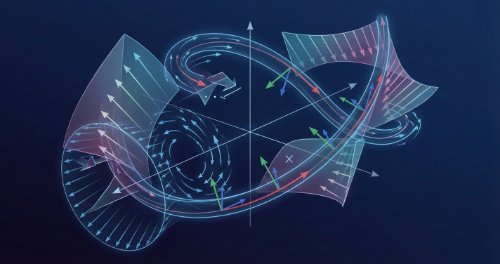
You will master the full spectrum of vector operations including dot, cross, and triple products, and apply them to solve geometric problems and vector equations. You will acquire the skills to analyze the differential geometry of curves using the Frenet-Serret framework and apply the powerful gradient, divergence, curl, and Laplacian operators in various coordinate systems. Completion establishes the critical mathematical foundation demanded for advanced studies in continuum mechanics, electrodynamics, and theoretical physics.
MTH 210: Vector Analysis
Vector analysis is the mathematical backbone of classical mechanics, electromagnetism, and fluid dynamics. This learning track delivers the complete NUC CCMAS MTH 210 curriculum, rigorously progressing from fundamental vector algebra to the advanced differential and integral calculus of scalar and vector fields used in complex engineering and scientific modelling. This programme is targeted at undergraduates in engineering, physics, mathematics, and computer science. It provides the essential mathematical toolkit for students entering disciplines that rely on applied mathematics and spatial analysis, and serves as a rigorous refresher for professionals needing to solidify their command of vector principles. You will master the full spectrum of vector operations including dot, cross, and triple products, and apply them to solve geometric problems and vector equations. You will acquire the skills to analyze the differential geometry of curves using the Frenet-Serret framework and apply the powerful gradient, divergence, curl, and Laplacian operators in various coordinate systems. Completion establishes the critical mathematical foundation demanded for advanced studies in continuum mechanics, electrodynamics, and theoretical physics.
Course Chapters