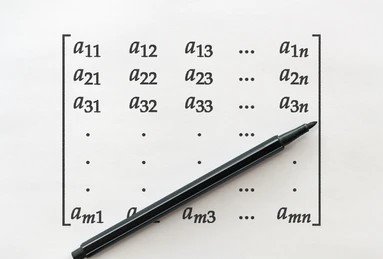
Linear Vector Spaces - Linear Algebra (Undergraduate Advanced)

Do you want to learn how to work with abstract spaces and transformations that preserve their structure? Do you want to understand the concepts of vector subspaces, linear combinations, linear dependence, basis, dimension, coordinates, and properties of vector spaces? Do you want to master the skills of defining and manipulating linear maps, their kernels, images, matrix representations, and transition matrices? If you answered yes to any of these questions, then this course is for you! Linear Algebra: Linear Vector Spaces and Linear Maps is a comprehensive and engaging course that covers the fundamentals of vector spaces and linear maps and their applications in mathematics and science. You will learn how to: - Define and classify vector spaces and their subspaces over a given scalar field - Perform operations on vectors using linear combinations and scalar multiplication - Determine whether a set of vectors is linearly dependent or independent and find a basis and dimension for a vector space or subspace - Find the coordinates of a vector with respect to a given basis and change the basis using transition matrices - Define and classify linear maps between vector spaces and find their domains, codomains, ranges, and null spaces - Find the kernel and image of a linear map and use them to determine whether a linear map is one-to-one or onto - Represent a linear map using a matrix and perform matrix operations such as addition, multiplication, and inversion - Use different methods and tools to solve systems of linear equations, such as Gaussian elimination, row reduction, and inverse matrices This course is suitable for anyone who wants to learn or review the basics of vector spaces and linear maps and their applications. It is especially useful for students and professionals in algebra, geometry, analysis, differential equations, optimization, cryptography, computer graphics, data science, and other related fields. By the end of this course, you will have a solid foundation of the theory and practice of vector spaces and linear maps and their operations. You will also be able to apply the knowledge and skills you learned to real-world problems and challenges that involve vector spaces and linear maps. Once enrolled, you have access to dynamic video lessons, interactive quizzes, and live chat support for an immersive learning experience. You engage with clear video explanations, test your understanding with instant-feedback quizzes and interact with our expert instructor and peers in the chat room. Join a supportive learning community to exchange ideas, ask questions, and collaborate with peers as you master the material, by enrolling right away.

22 hrs

Enrolment valid for 12 months
This course is also part of the following learning tracks. You may join a track to gain comprehensive knowledge across related courses.
MTH 202: Mathematical Methods II
Comprehensive treatise of advanced mathematics covering vector calculus, complex numbers, linear vector spaces, linear maps, matrices, eigenvalues and eigenvectors. Curated for second-year students of engineering and physical sciences at Obafemi Awolowo University, Ile-Ife, Nigeria. Students and professionals with similar learning goal will also find this learning track useful.

Comprehensive treatise of advanced mathematics covering vector calculus, complex numbers, linear vector spaces, linear maps, matrices, eigenvalues and eigenvectors. Curated for second-year students of engineering and physical sciences at Obafemi Awolowo University, Ile-Ife, Nigeria. Students and professionals with similar learning goal will also find this learning track useful.

See more
MTH 204: Linear Algebra I
Master the algebraic structures that underpin modern science and computation. This academic track delivers the complete NUC CCMAS MTH 204 curriculum, moving rigorously from abstract vector spaces to practical matrix theory. It provides the essential mathematical toolkit required for advanced problem-solving in high-demand STEM fields. This programme is targeted at undergraduates in mathematics, engineering, and computer science requiring a firm grounding in linear structures. It also serves professionals in data science, cryptography, and machine learning needing a rigorous theoretical refresher on foundational concepts. You will achieve competence in manipulating abstract vector spaces, determining basis and dimension, and analyzing linear transformations through their kernels and images. You will master matrix arithmetic, compute determinants, solve systems of linear equations using advanced methods, and apply techniques of eigenvalues and diagonalization. Completion establishes the critical foundation demanded for advanced studies in multivariate calculus, differential equations, and complex computational algorithms.

Master the algebraic structures that underpin modern science and computation. This academic track delivers the complete NUC CCMAS MTH 204 curriculum, moving rigorously from abstract vector spaces to practical matrix theory. It provides the essential mathematical toolkit required for advanced problem-solving in high-demand STEM fields. This programme is targeted at undergraduates in mathematics, engineering, and computer science requiring a firm grounding in linear structures. It also serves professionals in data science, cryptography, and machine learning needing a rigorous theoretical refresher on foundational concepts. You will achieve competence in manipulating abstract vector spaces, determining basis and dimension, and analyzing linear transformations through their kernels and images. You will master matrix arithmetic, compute determinants, solve systems of linear equations using advanced methods, and apply techniques of eigenvalues and diagonalization. Completion establishes the critical foundation demanded for advanced studies in multivariate calculus, differential equations, and complex computational algorithms.

See more

Course Chapters

1. Introduction
9
Definition of a space, linear vector space, with examples.
Concept Overviews
9 Lessons
2:40:20
2. Vector Subspaces
1
3
Definition and examples of linear vector subspaces.
Concept Overviews
1 Lesson
18:13
Problem Walkthroughs
3 Lessons
2:31:44
3. Linear Combinations and Spans
3
4
Linear combinations of two or more vectors and linear spans of vector spaces.
Concept Overviews
3 Lessons
1:03:13
Problem Walkthroughs
4 Lessons
2:11:19
4. Linear Dependence and Independence
1
3
Linear dependence and independence of vectors in a vector space.
Concept Overviews
1 Lesson
18:57
Problem Walkthroughs
3 Lessons
1:58:30
5. Basis and Dimension
1
3
Basis and dimension of linear vector spaces.
Concept Overviews
1 Lesson
12:52
Problem Walkthroughs
3 Lessons
3:01:18
6. Matrix Spaces
3
Meaning, bases and dimensions of vector spaces derived from matrices - row, column and null spaces.
Concept Overviews
3 Lessons
1:33:56
7. Sums and Intersections
2
1
Sums and intersections of subspaces of a vector space - their basis, dimension and other properties.
Concept Overviews
2 Lessons
25:36
Problem Walkthroughs
1 Lesson
1:25:26
8. Coordinates
1
1
Meaning of coordinates of a vector in a vector space with respect to a given basis, and how to find the coordinates.
Concept Overviews
1 Lesson
17:07
Problem Walkthroughs
1 Lesson
15:54