Definite Integrals and Numerical Methods - Calculus (Undergraduate Foundation)
$ 9.99

AMS 102: Basic Mathematics
Management and administration require precise numerical logic for decision-making. This track follows the official NUC CCMAS syllabus for AMS 102, covering real numbers, set theory, and complex systems. You will master algebraic operations, permutations, and combinations alongside the foundations of trigonometry and calculus. It provides the mathematical tools to model financial trends, handle business data, and solve optimisation problems in corporate settings.
This programme is built for first-year university students in Accounting, Business Administration, Banking, Finance, and Public Administration. It also serves secondary school leavers preparing for management degrees and professionals needing a refresher on business mathematics. It is suitable for anyone moving into roles that demand accurate quantitative analysis and logical deduction.
You will gain the ability to simplify complex business formulas, calculate probabilities for risk assessment, and find the exact points where profits are highest. You will be able to handle sequences for interest calculations and use differentiation to manage production costs. Completing this track ensures success in university examinations and builds the analytical strength required for careers in financial analysis, auditing, and strategic management.
AMS 102: Basic Mathematics
Management and administration require precise numerical logic for decision-making. This track follows the official NUC CCMAS syllabus for AMS 102, covering real numbers, set theory, and complex systems. You will master algebraic operations, permutations, and combinations alongside the foundations of trigonometry and calculus. It provides the mathematical tools to model financial trends, handle business data, and solve optimisation problems in corporate settings. This programme is built for first-year university students in Accounting, Business Administration, Banking, Finance, and Public Administration. It also serves secondary school leavers preparing for management degrees and professionals needing a refresher on business mathematics. It is suitable for anyone moving into roles that demand accurate quantitative analysis and logical deduction. You will gain the ability to simplify complex business formulas, calculate probabilities for risk assessment, and find the exact points where profits are highest. You will be able to handle sequences for interest calculations and use differentiation to manage production costs. Completing this track ensures success in university examinations and builds the analytical strength required for careers in financial analysis, auditing, and strategic management.
MTH 102: Elementary Mathematics II - Calculus
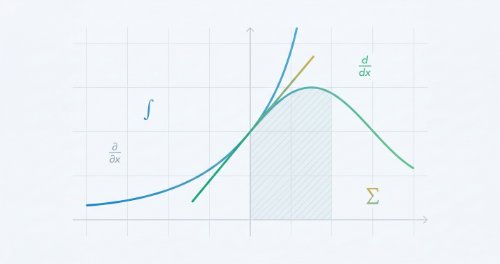
Calculus is the mathematical tool for measuring change and finding the best results in any system. This track follows the official NUC CCMAS MTH 102 curriculum to teach you how functions behave, how to calculate exact rates of change, and how to sum up tiny movements to find total areas or volumes. You will move from basic limits to complex integration techniques used to solve practical problems in the physical world.
This track is for first-year university students in engineering, science, and economics departments across Nigeria. It also serves secondary school leavers preparing for technical degrees or university entrance exams. Anyone needing to build a strong foundation in mathematical logic for data analysis or professional licensing will find these lessons essential.
After finishing this programme, you will calculate derivatives using first principles and shortcuts, find turning points for optimisation, and solve definite integrals for land measurement or tank design. You will use the trapezium and Simpson's rules to handle experimental data accurately. These skills ensure you pass your university exams and excel in technical careers like civil engineering, physics research, or financial forecasting.
MTH 102: Elementary Mathematics II - Calculus
Calculus is the mathematical tool for measuring change and finding the best results in any system. This track follows the official NUC CCMAS MTH 102 curriculum to teach you how functions behave, how to calculate exact rates of change, and how to sum up tiny movements to find total areas or volumes. You will move from basic limits to complex integration techniques used to solve practical problems in the physical world. This track is for first-year university students in engineering, science, and economics departments across Nigeria. It also serves secondary school leavers preparing for technical degrees or university entrance exams. Anyone needing to build a strong foundation in mathematical logic for data analysis or professional licensing will find these lessons essential. After finishing this programme, you will calculate derivatives using first principles and shortcuts, find turning points for optimisation, and solve definite integrals for land measurement or tank design. You will use the trapezium and Simpson's rules to handle experimental data accurately. These skills ensure you pass your university exams and excel in technical careers like civil engineering, physics research, or financial forecasting.
Course Chapters