MTH 102: Elementary Mathematics II - Calculus
$ 23.99
Learning Track Courses
Functions, Limits and Continuity - Calculus (Undergraduate Foundation)
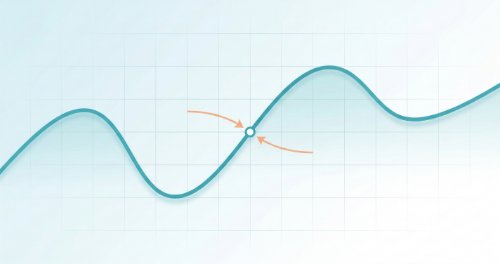
Calculus begins where algebra ends. This course builds the exact foundation you need to understand function behaviour. You will study function types, graph transformations, and arithmetic operations before moving to limit evaluation and continuity analysis. The lessons progress from basic definitions to advanced techniques, including factorisation, rationalisation, the squeeze theorem, and the intermediate value theorem. Each topic pairs instruction with targeted practice problems to confirm your grasp.
These concepts drive engineering calculations, economic modelling, physics simulations, and algorithm design. You will manipulate functions to predict system responses, evaluate limits to handle sudden data changes, and apply continuity principles when modelling physical or financial processes. Mastering this material replaces formula memorisation with reliable problem-solving for technical work.
You will identify the domain and range of complex expressions, sketch transformed graphs, and calculate composite and inverse functions. You will evaluate limits through direct substitution, algebraic manipulation, trigonometric identities, and the squeeze theorem. You will test for continuity at specific points, classify discontinuity types, and apply the intermediate value theorem across intervals.
This course serves university students preparing for first-year mathematics, secondary school graduates entering science programmes, and developers or analysts needing quantitative skills. Professionals returning to mathematics will rebuild speed and accuracy through structured exercises. Anyone processing technical data will apply these methods daily, regardless of degree title.
Functions, Limits and Continuity - Calculus (Undergraduate Foundation)
Calculus begins where algebra ends. This course builds the exact foundation you need to understand function behaviour. You will study function types, graph transformations, and arithmetic operations before moving to limit evaluation and continuity analysis. The lessons progress from basic definitions to advanced techniques, including factorisation, rationalisation, the squeeze theorem, and the intermediate value theorem. Each topic pairs instruction with targeted practice problems to confirm your grasp. These concepts drive engineering calculations, economic modelling, physics simulations, and algorithm design. You will manipulate functions to predict system responses, evaluate limits to handle sudden data changes, and apply continuity principles when modelling physical or financial processes. Mastering this material replaces formula memorisation with reliable problem-solving for technical work. You will identify the domain and range of complex expressions, sketch transformed graphs, and calculate composite and inverse functions. You will evaluate limits through direct substitution, algebraic manipulation, trigonometric identities, and the squeeze theorem. You will test for continuity at specific points, classify discontinuity types, and apply the intermediate value theorem across intervals. This course serves university students preparing for first-year mathematics, secondary school graduates entering science programmes, and developers or analysts needing quantitative skills. Professionals returning to mathematics will rebuild speed and accuracy through structured exercises. Anyone processing technical data will apply these methods daily, regardless of degree title.

Fundamentals and Techniques of Differentiation - Calculus (Undergraduate Foundation)
Differentiation measures how quantities change at exact moments. This course builds your complete calculus foundation from first principles to advanced methods. We start with rates of change and formal notation, then cover definitions, continuity, differentiability, and direct proofs. The sequence moves through core rules, composite functions, implicit techniques, parametric systems, and higher-order operations. Each concept links to targeted exercises that test your accuracy before you proceed.
These methods solve real problems in physics, engineering, finance, and software development. You will track speed, predict growth, calculate structural stress, and measure market sensitivity. Software developers apply these calculations to optimise machine learning models. Business analysts use them to adjust variables for target profits. The techniques here convert abstract equations into working tools for daily technical tasks.
You will calculate derivatives for polynomial, trigonometric, exponential, logarithmic, and hyperbolic functions without reference material. You will apply the product rule, quotient rule, and chain rule to complex expressions. You will perform implicit, parametric, and logarithmic differentiation. You will compute second-order and higher-order derivatives for standard forms. You will verify differential equations through systematic steps. Every lesson forces active practice and precise calculation.
The material suits first-year university students, polytechnic learners, and independent learners who require a solid calculus base. Secondary school graduates will gain the exact preparation needed for advanced science and mathematics exams. Technical professionals can use the content to refresh forgotten methods or build reliable calculation habits. The explanations skip heavy theory and focus on working steps. Anyone who handles data, graphs, or mathematical models will apply the methods immediately. You will solve standard calculus problems independently.
Fundamentals and Techniques of Differentiation - Calculus (Undergraduate Foundation)
Differentiation measures how quantities change at exact moments. This course builds your complete calculus foundation from first principles to advanced methods. We start with rates of change and formal notation, then cover definitions, continuity, differentiability, and direct proofs. The sequence moves through core rules, composite functions, implicit techniques, parametric systems, and higher-order operations. Each concept links to targeted exercises that test your accuracy before you proceed. These methods solve real problems in physics, engineering, finance, and software development. You will track speed, predict growth, calculate structural stress, and measure market sensitivity. Software developers apply these calculations to optimise machine learning models. Business analysts use them to adjust variables for target profits. The techniques here convert abstract equations into working tools for daily technical tasks. You will calculate derivatives for polynomial, trigonometric, exponential, logarithmic, and hyperbolic functions without reference material. You will apply the product rule, quotient rule, and chain rule to complex expressions. You will perform implicit, parametric, and logarithmic differentiation. You will compute second-order and higher-order derivatives for standard forms. You will verify differential equations through systematic steps. Every lesson forces active practice and precise calculation. The material suits first-year university students, polytechnic learners, and independent learners who require a solid calculus base. Secondary school graduates will gain the exact preparation needed for advanced science and mathematics exams. Technical professionals can use the content to refresh forgotten methods or build reliable calculation habits. The explanations skip heavy theory and focus on working steps. Anyone who handles data, graphs, or mathematical models will apply the methods immediately. You will solve standard calculus problems independently.
Applications of Differentiation - Calculus (Undergraduate Foundation)
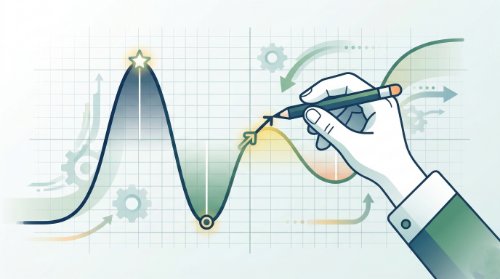
Finding turning points is the core of this calculus course. You will locate stationary points where change stops and reverses. We cover identifying maxima and minima using direct mathematical tests. You will find points of inflection where a curve changes its bend. You will learn to sketch complex graphs by hand using these specific markers.
Engineers and managers use these tools for optimisation and reducing waste. You can find the best size for a tank to use the least metal or the best speed to save petrol. In business, these methods help find the price that earns the most profit while keeping costs at the lowest level. Mastering these applications helps you solve real problems where you must find the best possible outcome for a physical system.
By the end, you will find and name all stationary points on any graph. You will use derivative tests to prove if a point is a maximum, a minimum, or an inflection point. You will identify where a curve is concave or convex. You will sketch extreme curves showing all intercepts, turning points, and asymptotes clearly without needing a calculator.
This course serves undergraduate foundation students and those entering engineering or management. It is for anyone needing to understand how different factors change together in science or business. Even those outside these fields gain the logic needed for technical problem-solving. These skills are essential for anyone who needs to study physical systems and find the most efficient ways to work.
Applications of Differentiation - Calculus (Undergraduate Foundation)
Finding turning points is the core of this calculus course. You will locate stationary points where change stops and reverses. We cover identifying maxima and minima using direct mathematical tests. You will find points of inflection where a curve changes its bend. You will learn to sketch complex graphs by hand using these specific markers. Engineers and managers use these tools for optimisation and reducing waste. You can find the best size for a tank to use the least metal or the best speed to save petrol. In business, these methods help find the price that earns the most profit while keeping costs at the lowest level. Mastering these applications helps you solve real problems where you must find the best possible outcome for a physical system. By the end, you will find and name all stationary points on any graph. You will use derivative tests to prove if a point is a maximum, a minimum, or an inflection point. You will identify where a curve is concave or convex. You will sketch extreme curves showing all intercepts, turning points, and asymptotes clearly without needing a calculator. This course serves undergraduate foundation students and those entering engineering or management. It is for anyone needing to understand how different factors change together in science or business. Even those outside these fields gain the logic needed for technical problem-solving. These skills are essential for anyone who needs to study physical systems and find the most efficient ways to work.
Fundamentals and Techniques of Integration - Calculus (Undergraduate Foundation)
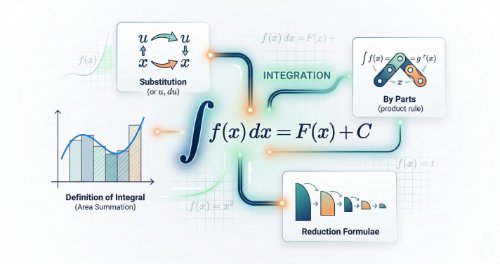
Integration is the essential tool for summing tiny changes into whole totals. This course covers the reversal of differentiation to find areas, volumes, and precise solutions. You will learn how to handle indefinite integrals and master core methods like substitution and integration by parts. The curriculum also includes reduction formulae to simplify repeated, complex calculations. Mastering these techniques is the first step toward solving the advanced problems found in engineering and the physical sciences.
Engineers and scientists use these methods to design structures, predict natural events, and build hardware. Knowledge of integration allows you to calculate the work done by varying forces or the exact flow of fluids in a system. If you plan to work in technical fields or handle data-driven projects, these calculations are unavoidable. This course provides the practical math needed to turn abstract formulas into real-world applications and professional results.
After completing these modules, you will correctly identify and apply the right integration technique for any given problem. You will solve indefinite integrals using standard rules and perform variable changes through the substitution method. You will also manage products of functions using integration by parts and apply reduction formulae to streamline long processes. These skills prepare you to tackle the differential equations required in higher university years and professional licensing exams.
This course is for undergraduate students in engineering, mathematics, and the sciences seeking a firm foundation in calculus. It also serves secondary school leavers who want to prepare for the rigours of university-level technical courses. Even for those outside of science tracks, the logic and step-by-step methods taught here improve general analytical thinking and problem-solving. This training ensures you meet the international standards expected in any modern technical career.
Fundamentals and Techniques of Integration - Calculus (Undergraduate Foundation)
Integration is the essential tool for summing tiny changes into whole totals. This course covers the reversal of differentiation to find areas, volumes, and precise solutions. You will learn how to handle indefinite integrals and master core methods like substitution and integration by parts. The curriculum also includes reduction formulae to simplify repeated, complex calculations. Mastering these techniques is the first step toward solving the advanced problems found in engineering and the physical sciences. Engineers and scientists use these methods to design structures, predict natural events, and build hardware. Knowledge of integration allows you to calculate the work done by varying forces or the exact flow of fluids in a system. If you plan to work in technical fields or handle data-driven projects, these calculations are unavoidable. This course provides the practical math needed to turn abstract formulas into real-world applications and professional results. After completing these modules, you will correctly identify and apply the right integration technique for any given problem. You will solve indefinite integrals using standard rules and perform variable changes through the substitution method. You will also manage products of functions using integration by parts and apply reduction formulae to streamline long processes. These skills prepare you to tackle the differential equations required in higher university years and professional licensing exams. This course is for undergraduate students in engineering, mathematics, and the sciences seeking a firm foundation in calculus. It also serves secondary school leavers who want to prepare for the rigours of university-level technical courses. Even for those outside of science tracks, the logic and step-by-step methods taught here improve general analytical thinking and problem-solving. This training ensures you meet the international standards expected in any modern technical career.

Definite Integrals and Numerical Methods - Calculus (Undergraduate Foundation)
Calculate exact areas and volumes using definite integrals and numerical approximations. You will solve definite integrals using standard integration techniques and handle complex shapes with the Trapezium and Simpson's rules. This content focuses on finding the total area under a curve and the volume of objects formed when a shape rotates around an axis.
These methods are essential for measuring irregular land plots, designing water tanks, and calculating the weight of machine parts. Civil, mechanical, and agricultural engineers use these tools daily to ensure structures are safe and materials are used efficiently. Knowing how to approximate answers is vital when you face real-life data that does not fit a simple textbook formula.
You will evaluate definite integrals, find the area between two curves, and calculate the volume of solids of revolution. You will also master numerical methods like the Trapezium rule and Simpson's rule to get accurate results from experimental data. This training enables you to solve practical measurement problems in any technical field.
This course is for undergraduate science and engineering students who need a strong mathematical base. Secondary school leavers intending to study technical courses will find this a necessary head start. Even those not in engineering will improve their ability to handle data and understand how physical objects are measured in the real world.
Definite Integrals and Numerical Methods - Calculus (Undergraduate Foundation)
Calculate exact areas and volumes using definite integrals and numerical approximations. You will solve definite integrals using standard integration techniques and handle complex shapes with the Trapezium and Simpson's rules. This content focuses on finding the total area under a curve and the volume of objects formed when a shape rotates around an axis. These methods are essential for measuring irregular land plots, designing water tanks, and calculating the weight of machine parts. Civil, mechanical, and agricultural engineers use these tools daily to ensure structures are safe and materials are used efficiently. Knowing how to approximate answers is vital when you face real-life data that does not fit a simple textbook formula. You will evaluate definite integrals, find the area between two curves, and calculate the volume of solids of revolution. You will also master numerical methods like the Trapezium rule and Simpson's rule to get accurate results from experimental data. This training enables you to solve practical measurement problems in any technical field. This course is for undergraduate science and engineering students who need a strong mathematical base. Secondary school leavers intending to study technical courses will find this a necessary head start. Even those not in engineering will improve their ability to handle data and understand how physical objects are measured in the real world.