Electromagnetic Induction and Inductance - Physics (Undergraduate Foundation)

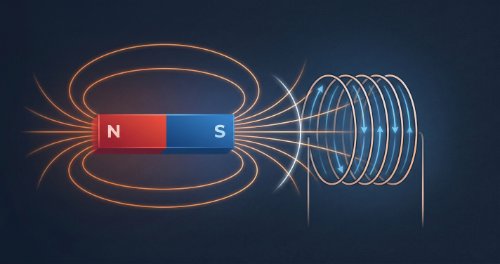
Most electricity comes from moving magnets. This course explains how changing magnetic fields create electric currents. You will learn magnetic flux, Faraday’s law, and Lenz’s law to understand how motion creates power. We also cover self and mutual inductance alongside the core principles of how transformers change voltage levels. These principles run the modern power grid, motors, and generators. This knowledge is essential for careers in power engineering, electronics, and renewable energy. You will use these concepts to design circuits, maintain industrial machines, or build stable power supply units for various technical projects. You will learn to calculate magnetic flux and predict induced current directions accurately. You will solve equations for electromotive force and inductance in different conductors. You will also learn how step-up and step-down transformers work to move electricity over long distances while reducing energy loss. This course suits undergraduate engineering and physics students needing a strong start. It helps secondary school leavers prepare for university-level science. Hobbyists building electrical tools or motors will also benefit from learning exactly how coils and magnets interact.

Enrolment valid for 12 months
This course is also part of the following learning track. You may join the track to gain comprehensive knowledge across related courses.
PHY 102: General Physics II - Electricity and Magnetism
Electricity and magnetism run every home, factory, and phone all over the world. This track builds the technical foundation to master laws governing electrical energy and signals. You will progress from stationary charges to alternating current and electromagnetic waves. It simplifies the NUC CCMAS syllabus into actionable knowledge for solving practical technical problems. The programme is for first-year university and polytechnic students in engineering or physical sciences. It also serves school leavers preparing for university physics or technical entrance exams. Science teachers and technicians who need a solid refresher on core electrical principles will find the material direct and relevant to their work. You will learn to calculate electrical forces, design functional DC and AC circuits, and predict how magnetic fields drive motors and generators. You will master the use of Gauss's Law, Kirchhoff's rules, and Maxwell's equations to solve engineering challenges. Completing this track ensures success in PHY 102 exams and prepares you for a career in power systems, telecommunications, or renewable energy.

Electricity and magnetism run every home, factory, and phone all over the world. This track builds the technical foundation to master laws governing electrical energy and signals. You will progress from stationary charges to alternating current and electromagnetic waves. It simplifies the NUC CCMAS syllabus into actionable knowledge for solving practical technical problems. The programme is for first-year university and polytechnic students in engineering or physical sciences. It also serves school leavers preparing for university physics or technical entrance exams. Science teachers and technicians who need a solid refresher on core electrical principles will find the material direct and relevant to their work. You will learn to calculate electrical forces, design functional DC and AC circuits, and predict how magnetic fields drive motors and generators. You will master the use of Gauss's Law, Kirchhoff's rules, and Maxwell's equations to solve engineering challenges. Completing this track ensures success in PHY 102 exams and prepares you for a career in power systems, telecommunications, or renewable energy.

See more

Course Chapters

1. Introduction
5
2
This chapter establishes the relationship between electrostatic forces and the energy required to move charges. You will understand how work is converted into electrical potential energy in a field. You will define electric potential energy; master the concept of potential difference; apply the conservation of energy to moving charges; and convert energy values between Joules and electron-volts.
Concept Overviews
5 Lessons
Problem Walkthroughs
2 Lessons
2. Electric Potential
6
3
This chapter explores the spatial distribution of potential around various charge configurations. You will learn to map electrical pressure and link it directly to the surrounding electric field. You will calculate potential for point charges and continuous distributions; apply the superposition principle; identify equipotential surfaces; and derive field strength from potential gradients.
Concept Overviews
6 Lessons
Problem Walkthroughs
3 Lessons
3. Electric Dipoles
1
2
This chapter examines the potential created by pairs of equal and opposite charges. Dipole analysis is essential for understanding molecular interactions and dielectric material properties. You will master the potential formulas for electric dipoles; calculate potential at axial positions; and determine potential at arbitrary angular points in space.
Concept Overviews
1 Lesson
Problem Walkthroughs
2 Lessons
4. Capacitance
3
2
Capacitors are fundamental devices used to store charge and energy in electrical circuits. You will learn the physical factors that determine how much energy a device can hold. You will define capacitance and the unit Farad; calculate values for parallel plate capacitors; and determine the total electrical energy stored in various charging states.
Concept Overviews
3 Lessons
Problem Walkthroughs
2 Lessons
5. Capacitor Networks
3
2
Components in circuits are combined to achieve specific capacitance and voltage handling values. This chapter teaches you to simplify complex arrangements into equivalent single values. You will master series and parallel connection rules; solve for equivalent capacitance in mixed networks; and calculate voltage distribution across individual circuit components.
Concept Overviews
3 Lessons
Problem Walkthroughs
2 Lessons
6. Dielectrics
4
2
Dielectric materials enhance the charge storage capacity and safety of real-world capacitors. This chapter explains the physics of insulating materials when placed inside electric fields. You will master dielectric polarisation and constants; calculate increased capacitance values; and determine maximum charge limits before electrical breakdown occurs.
Concept Overviews
4 Lessons
Problem Walkthroughs
2 Lessons
7. Conclusion
1
This final chapter reviews the relationships between electric potential, energy, and charge storage. It consolidates the principles mastered throughout the course for application in circuits. You will summarise the core laws of potential and capacitance and prepare for advanced topics in current electricity and electronic design.
Concept Overviews
1 Lesson