Introduction to Relations, Mappings and Functions - Mathematics (Undergraduate Foundation)
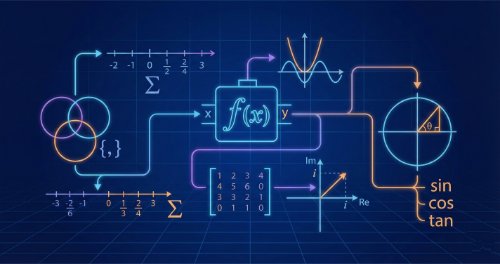
Master the architecture of mathematical dependencies. This course provides a rigorous foundation in relations, mappings, and functions, which are the essential tools used to model connections between abstract mathematical sets. We progress rapidly from defining basic binary relations and analyzing properties such as reflexivity, symmetry, and transitivity, to the precise mechanics of functions. You will examine the strict rules governing inputs, outputs, domains, and codomains that differentiate a functional mapping from a general relation. Functional literacy is non-negotiable in quantitative professional fields. Computer scientists rely heavily on the concept of mappings for algorithm design, database structuring, and functional programming paradigms. Simultaneously, engineers, economists, and data analysts use functions as the primary method to model complex real-world systems, define variables, and predict outcomes based on specific inputs. This framework is indispensable for anyone required to analyze causal relationships or build predictive models professionally. Upon completion, you will possess the skills to rigorously define binary relations and identify equivalence properties within sets. You will accurately distinguish mappings from general relations, determine domains, codomains, and ranges with precision. Crucially, you will acquire the competence to classify functions structurally as injective (one-to-one), surjective (onto), or bijective, and perform essential operations including function composition and the determination of inverse mappings. This course is designed for students entering undergraduate foundation programmes requiring strong analytical bases, particularly in mathematics, computer science, and engineering disciplines. It also acts as an intensive, high-level refresher for professionals returning to academia or shifting into technical roles that demand precise logical structuring. Prior exposure to elementary algebra and basic set notation is assumed; focus is placed strictly on the mastery and application of these core definitions.

Enrolment valid for 12 months
This course is also part of the following learning track. You may join the track to gain comprehensive knowledge across related courses.
MTH 101: Elementary Mathematics I - Algebra and Trigonometry
Master the foundational mathematical structures essential for success in quantitative undergraduate degrees and professional technical roles. This comprehensive learning track delivers a rigorous treatment of algebra and trigonometry, moving rapidly from fundamental set theory and real number operations to advanced topics including matrix algebra, complex numbers, and analytical trigonometry. You will establish the critical problem-solving framework required for advanced study in calculus, engineering mechanics, and data science. This programme is primarily designed for first-year university students in STEM disciplines requiring strong analytical bases, particularly engineering, physics, computer science, and economics. It also serves as an intensive, high-level refresher for professionals returning to academia or shifting into data-driven roles demanding precise numerical literacy and logical structuring. Prior competence in standard secondary school mathematics is assumed; focus is placed strictly on mastery and application of core definitions. Upon completion, you will possess the skills to construct rigorous logical arguments using set theory and mathematical induction, model complex relationships with functions and matrices, and analyze periodic systems using advanced trigonometry. You will demonstrate competence in solving diverse equation types, from quadratics to linear systems, and manipulating complex numbers in engineering applications. This track prepares you directly for the mathematical demands of second-year university studies and technical professional certification exams.

Master the foundational mathematical structures essential for success in quantitative undergraduate degrees and professional technical roles. This comprehensive learning track delivers a rigorous treatment of algebra and trigonometry, moving rapidly from fundamental set theory and real number operations to advanced topics including matrix algebra, complex numbers, and analytical trigonometry. You will establish the critical problem-solving framework required for advanced study in calculus, engineering mechanics, and data science. This programme is primarily designed for first-year university students in STEM disciplines requiring strong analytical bases, particularly engineering, physics, computer science, and economics. It also serves as an intensive, high-level refresher for professionals returning to academia or shifting into data-driven roles demanding precise numerical literacy and logical structuring. Prior competence in standard secondary school mathematics is assumed; focus is placed strictly on mastery and application of core definitions. Upon completion, you will possess the skills to construct rigorous logical arguments using set theory and mathematical induction, model complex relationships with functions and matrices, and analyze periodic systems using advanced trigonometry. You will demonstrate competence in solving diverse equation types, from quadratics to linear systems, and manipulating complex numbers in engineering applications. This track prepares you directly for the mathematical demands of second-year university studies and technical professional certification exams.

See more

Course Chapters

1. Introduction
6
This chapter establishes the fundamental transition from set theory to relational algebra. You will master the formal definitions required to model interactions between data sets, providing the logical bedrock for all subsequent study of functional dependencies and mappings. You will master: defining binary relations through ordered pairs; identifying domain, codomain, and range; representing relations via arrow diagrams and matrices; and distinguishing between basic types of relations.
Concept Overviews
6 Lessons
2. Operations on Functions
4
This chapter covers the algebraic manipulation and structural synthesis of functions. You will master the mechanics of combining disparate mappings to model complex system behaviours, establishing the computational proficiency required for algorithm design and advanced calculus. You will master: executing basic arithmetic operations on functions; defining composite functions through nested mappings; determining domains of combined functions; and verifying the associative property of composition.
Concept Overviews
4 Lessons
3. One-to-One and Onto Functions
4
This chapter examines the structural classification of mappings based on element distribution. Mastering these classifications is critical for determining function invertibility and ensuring logical consistency in data modelling and relational architecture. You will master: defining injective functions via unique element mapping; identifying surjective functions through codomain exhaustion; classifying bijective functions for bidirectional mapping; and verifying these properties using horizontal line tests and algebraic proofs.
Concept Overviews
4 Lessons
4. Conclusion
2
This final chapter synthesises all foundational concepts to verify mastery of relational and functional structures. It serves as the critical validation stage, ensuring you can deploy these logical frameworks to model complex dependencies in advanced engineering and computational contexts. You will master: performing comprehensive structural analysis of complex mappings; executing multi-step functional proofs; reconciling relations with their inverse properties; and applying functional literacy to higher-order mathematical systems.
Concept Overviews
2 Lessons