MTH 101: Elementary Mathematics I - Algebra and Trigonometry
$ 23.99
Learning Track Courses
Set Theory - Mathematics (Undergraduate Foundation)
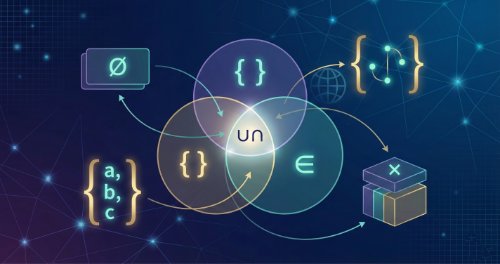
Mathematics begins with sets. This course covers everything from basic definitions and membership notations to complex set algebra and De Morgan's laws. You will master cardinality, power sets, and the classification of number systems including rational, irrational, and complex numbers. The curriculum moves from simple operations like union and intersection into element-wise proofs, Cartesian products, and the mechanics of relations and functions.
Set theory is the language of modern data and logic. These concepts are essential for computer programming, database management, and statistical analysis. Understanding functions and mappings allows you to model real-world dependencies in engineering, economics, and the sciences. Mastering these foundations provides the exact logical framework needed to solve complex problems in technology and research.
Upon completion, you will be able to simplify set expressions and solve grouping problems using Venn diagrams and the inclusion-exclusion principle. You will know how to perform element-wise proofs and calculate set cardinalities. You will also gain the ability to evaluate composite functions and prove whether a mapping is one-to-one, onto, or bijective.
This course is designed for undergraduate students and secondary school leavers entering STEM disciplines. It provides a necessary logical foundation for anyone moving into calculus, data science, or advanced mathematics. The clear, direct instruction ensures that any student can develop the systematic thinking required for professional technical roles.
Set Theory - Mathematics (Undergraduate Foundation)
Mathematics begins with sets. This course covers everything from basic definitions and membership notations to complex set algebra and De Morgan's laws. You will master cardinality, power sets, and the classification of number systems including rational, irrational, and complex numbers. The curriculum moves from simple operations like union and intersection into element-wise proofs, Cartesian products, and the mechanics of relations and functions. Set theory is the language of modern data and logic. These concepts are essential for computer programming, database management, and statistical analysis. Understanding functions and mappings allows you to model real-world dependencies in engineering, economics, and the sciences. Mastering these foundations provides the exact logical framework needed to solve complex problems in technology and research. Upon completion, you will be able to simplify set expressions and solve grouping problems using Venn diagrams and the inclusion-exclusion principle. You will know how to perform element-wise proofs and calculate set cardinalities. You will also gain the ability to evaluate composite functions and prove whether a mapping is one-to-one, onto, or bijective. This course is designed for undergraduate students and secondary school leavers entering STEM disciplines. It provides a necessary logical foundation for anyone moving into calculus, data science, or advanced mathematics. The clear, direct instruction ensures that any student can develop the systematic thinking required for professional technical roles.
Operations with Real Numbers - Mathematics (Undergraduate Foundation)
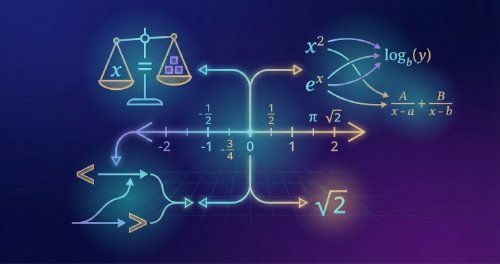
Mathematics requires absolute precision. This course provides a rigorous grounding in real number operations, from integers and rational numbers to complex systems and algebraic laws. You will learn to handle polynomials, solve equations ranging from linear to biquadratic, and navigate simultaneous systems. The syllabus covers inequalities, sign tables, partial fractions, indices, logarithms, and the systematic simplification of surds.
These tools are essential for success in engineering, accounting, and the sciences. Clear mathematical thinking allows you to model financial risks, calculate structural loads, and write efficient computer code. Proficiency in these operations ensures accuracy in any career that relies on quantitative data and logical deduction.
You will gain the ability to classify number systems, apply algebraic theorems, and solve complex equations in one or more unknowns. You will acquire the skills to manipulate inequalities, resolve algebraic fractions, and simplify expressions using the laws of indices and logarithms. The course provides the technical competence required to handle surds and find roots of compound expressions effectively.
This training is built for undergraduate foundation students and secondary school leavers entering university. It provides a necessary bridge for anyone needing to strengthen their mathematical base before advanced study. Even those in non-technical roles will find value in the disciplined analytical approach required to master these foundational concepts.
Operations with Real Numbers - Mathematics (Undergraduate Foundation)
Mathematics requires absolute precision. This course provides a rigorous grounding in real number operations, from integers and rational numbers to complex systems and algebraic laws. You will learn to handle polynomials, solve equations ranging from linear to biquadratic, and navigate simultaneous systems. The syllabus covers inequalities, sign tables, partial fractions, indices, logarithms, and the systematic simplification of surds. These tools are essential for success in engineering, accounting, and the sciences. Clear mathematical thinking allows you to model financial risks, calculate structural loads, and write efficient computer code. Proficiency in these operations ensures accuracy in any career that relies on quantitative data and logical deduction. You will gain the ability to classify number systems, apply algebraic theorems, and solve complex equations in one or more unknowns. You will acquire the skills to manipulate inequalities, resolve algebraic fractions, and simplify expressions using the laws of indices and logarithms. The course provides the technical competence required to handle surds and find roots of compound expressions effectively. This training is built for undergraduate foundation students and secondary school leavers entering university. It provides a necessary bridge for anyone needing to strengthen their mathematical base before advanced study. Even those in non-technical roles will find value in the disciplined analytical approach required to master these foundational concepts.
Sequences and Series - Mathematics (Undergraduate Foundation)
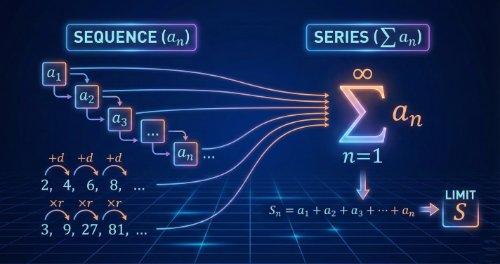
Master the algebraic rules governing ordered lists of numbers and their total sums. This course establishes a solid foundation in the mechanics of sequences and series. We investigate precise definitions for arithmetic and geometric progressions; use formal notation for general terms; and handle finite and infinite series using sigma notation. The curriculum focuses on the structural properties required for university-level mathematical analysis.
Knowing how to handle numerical patterns is vital for many modern careers. Financial analysts use geometric series to calculate compound interest, loan repayments, and annuities. Computer scientists use sequence structures to organise data sets and analyse computer loops. This knowledge is necessary for measuring growth, decay, and accumulation in business and science with absolute accuracy.
You will learn to identify and define sequences using general terms and recurrence formulas. You will calculate the nth term and the sum of terms for arithmetic, geometric, and harmonic progressions. You will master sigma notation; determine when infinite series converge; convert recurring decimals into fractions; and use formulas to sum natural numbers, squares, and cubes.
This course is for students entering university foundation programmes in mathematics, finance, or computer science. It serves as an intensive refresher for professionals returning to academia or shifting into roles that demand precise numerical work. Even those outside these fields will benefit from the sharp logical thinking and problem-solving speed developed through pattern analysis.
Sequences and Series - Mathematics (Undergraduate Foundation)
Master the algebraic rules governing ordered lists of numbers and their total sums. This course establishes a solid foundation in the mechanics of sequences and series. We investigate precise definitions for arithmetic and geometric progressions; use formal notation for general terms; and handle finite and infinite series using sigma notation. The curriculum focuses on the structural properties required for university-level mathematical analysis. Knowing how to handle numerical patterns is vital for many modern careers. Financial analysts use geometric series to calculate compound interest, loan repayments, and annuities. Computer scientists use sequence structures to organise data sets and analyse computer loops. This knowledge is necessary for measuring growth, decay, and accumulation in business and science with absolute accuracy. You will learn to identify and define sequences using general terms and recurrence formulas. You will calculate the nth term and the sum of terms for arithmetic, geometric, and harmonic progressions. You will master sigma notation; determine when infinite series converge; convert recurring decimals into fractions; and use formulas to sum natural numbers, squares, and cubes. This course is for students entering university foundation programmes in mathematics, finance, or computer science. It serves as an intensive refresher for professionals returning to academia or shifting into roles that demand precise numerical work. Even those outside these fields will benefit from the sharp logical thinking and problem-solving speed developed through pattern analysis.
Theory of Quadratic Equations - Mathematics (Undergraduate Foundation)
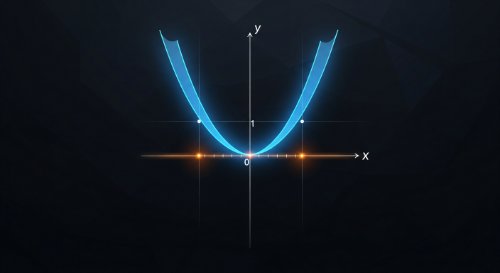
Quadratic equations are the bedrock of advanced algebra and the starting point for mastering non-linear mathematical models. This course provides a rigorous analysis of these equations, covering standard forms, solving methods like factorisation and completing the square, and the critical use of the discriminant to determine root nature. You will study turning points for optimisation, solve complex quadratic inequalities, and master the relationship between roots and coefficients to build equations from scratch.
Mastering these models is essential for careers in engineering, physics, and finance where trajectories and profit levels must be calculated precisely. You will use these principles to describe projectile motion, design parabolic structures, and identify boundary limits in economic models. This is the mathematics of optimisation, providing the necessary tools to find the highest or lowest possible values in any system governed by second-degree polynomials.
By the end of this course, you will solve any quadratic equation using multiple methods; use the discriminant to identify real, identical, or imaginary roots; and determine the location and value of turning points. You will master solving quadratic inequalities; identifying valid ranges for rational expressions; and using symmetric identities to evaluate root properties without solving the original equation. These skills form the essential foundation for calculus and mechanics.
This course is built for first-year university students in mathematics, physics, engineering, and economics who need a solid algebraic foundation. It also serves secondary school leavers preparing for advanced entrance exams or technical professionals looking to refresh their analytical skills. Even those in data science or basic programming will benefit from the logical structuring and problem-solving techniques required to handle non-linear variables.
Theory of Quadratic Equations - Mathematics (Undergraduate Foundation)
Quadratic equations are the bedrock of advanced algebra and the starting point for mastering non-linear mathematical models. This course provides a rigorous analysis of these equations, covering standard forms, solving methods like factorisation and completing the square, and the critical use of the discriminant to determine root nature. You will study turning points for optimisation, solve complex quadratic inequalities, and master the relationship between roots and coefficients to build equations from scratch. Mastering these models is essential for careers in engineering, physics, and finance where trajectories and profit levels must be calculated precisely. You will use these principles to describe projectile motion, design parabolic structures, and identify boundary limits in economic models. This is the mathematics of optimisation, providing the necessary tools to find the highest or lowest possible values in any system governed by second-degree polynomials. By the end of this course, you will solve any quadratic equation using multiple methods; use the discriminant to identify real, identical, or imaginary roots; and determine the location and value of turning points. You will master solving quadratic inequalities; identifying valid ranges for rational expressions; and using symmetric identities to evaluate root properties without solving the original equation. These skills form the essential foundation for calculus and mechanics. This course is built for first-year university students in mathematics, physics, engineering, and economics who need a solid algebraic foundation. It also serves secondary school leavers preparing for advanced entrance exams or technical professionals looking to refresh their analytical skills. Even those in data science or basic programming will benefit from the logical structuring and problem-solving techniques required to handle non-linear variables.

Mathematical Induction - Mathematics (Undergraduate Foundation)
Mathematical induction proves a statement is true for every whole number using a starting point and a logical link. It works like a chain reaction where one step confirms the next. This course explains the core principle and applies it to many types of problems. You will study standard series, fractional series, divisibility, and inequalities. The content also covers recursive sequences, matrix powers, and set theory to give you a complete understanding of the method.
Programmers use this logic to check that software code works without mistakes. Engineers use it to prove that formulas for structural designs or machines are safe. This skill is vital for anyone in technology, finance, or data science because it makes logical thinking a clear, repeatable process. It removes guesswork and provides the certainty needed for professional work in any technical field.
You will learn the three-step induction method to solve different kinds of mathematical proofs. You will prove formulas for series, check if expressions are divisible, and handle difficult inequalities. You will also find general formulas for repeating sequences and solve problems involving matrices and sets. By the end, you will write clear, logical proofs that are required for university mathematics examinations.
This course is for university students starting science or engineering degrees and senior secondary school students preparing for higher education. It is also helpful for workers who want to improve their reasoning and problem-solving. Even those not studying mathematics will benefit from the clear way of thinking this course teaches. It provides the basic skills needed for any career that requires logic and proof.
Mathematical Induction - Mathematics (Undergraduate Foundation)
Mathematical induction proves a statement is true for every whole number using a starting point and a logical link. It works like a chain reaction where one step confirms the next. This course explains the core principle and applies it to many types of problems. You will study standard series, fractional series, divisibility, and inequalities. The content also covers recursive sequences, matrix powers, and set theory to give you a complete understanding of the method. Programmers use this logic to check that software code works without mistakes. Engineers use it to prove that formulas for structural designs or machines are safe. This skill is vital for anyone in technology, finance, or data science because it makes logical thinking a clear, repeatable process. It removes guesswork and provides the certainty needed for professional work in any technical field. You will learn the three-step induction method to solve different kinds of mathematical proofs. You will prove formulas for series, check if expressions are divisible, and handle difficult inequalities. You will also find general formulas for repeating sequences and solve problems involving matrices and sets. By the end, you will write clear, logical proofs that are required for university mathematics examinations. This course is for university students starting science or engineering degrees and senior secondary school students preparing for higher education. It is also helpful for workers who want to improve their reasoning and problem-solving. Even those not studying mathematics will benefit from the clear way of thinking this course teaches. It provides the basic skills needed for any career that requires logic and proof.
Permutation and Combination - Mathematics (Undergraduate Foundation)
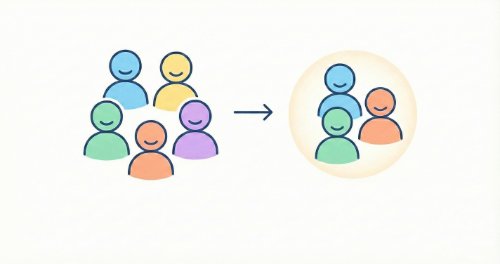
Stop counting one by one. This course provides the mathematical tools to calculate arrangements and selections with speed. You will master the fundamental counting rules including product, addition, subtraction, and division. The curriculum covers linear and cyclic permutations, identical objects, and restricted placements where items must be together or apart. We conclude with combinations, derangements, and the calculation of shapes within geometric frameworks.
Counting is the engine of probability and modern computing. These skills are vital for cryptography, software development, and statistical analysis. You will apply these methods to calculate network paths, secure passwords, and optimise logistics. In any technical career, the ability to quantify possibilities is the difference between guessing and knowing.
You will solve complex arrangement problems using standard formulas and logical shortcuts. You will handle specific constraints like fixed positions or items that cannot be next to each other. You will learn to distinguish between permutations and combinations in practical scenarios. You will also calculate the number of lines, triangles, and diagonals in geometric figures using combinatorial principles.
This foundation is for undergraduate students and secondary school leavers aiming for high scores in competitive exams. It is also essential for professionals in engineering, finance, and data science who require a refresher on discrete mathematics. Anyone seeking to improve their logical deduction and analytical speed will find value here.
Permutation and Combination - Mathematics (Undergraduate Foundation)
Stop counting one by one. This course provides the mathematical tools to calculate arrangements and selections with speed. You will master the fundamental counting rules including product, addition, subtraction, and division. The curriculum covers linear and cyclic permutations, identical objects, and restricted placements where items must be together or apart. We conclude with combinations, derangements, and the calculation of shapes within geometric frameworks. Counting is the engine of probability and modern computing. These skills are vital for cryptography, software development, and statistical analysis. You will apply these methods to calculate network paths, secure passwords, and optimise logistics. In any technical career, the ability to quantify possibilities is the difference between guessing and knowing. You will solve complex arrangement problems using standard formulas and logical shortcuts. You will handle specific constraints like fixed positions or items that cannot be next to each other. You will learn to distinguish between permutations and combinations in practical scenarios. You will also calculate the number of lines, triangles, and diagonals in geometric figures using combinatorial principles. This foundation is for undergraduate students and secondary school leavers aiming for high scores in competitive exams. It is also essential for professionals in engineering, finance, and data science who require a refresher on discrete mathematics. Anyone seeking to improve their logical deduction and analytical speed will find value here.
Binomial Theorem - Mathematics (Undergraduate Foundation)
Stop manually multiplying brackets. This course teaches the systematic expansion of binomial expressions using Pascal's triangle and the formal Binomial Theorem. We cover the fundamental proof for positive integers before moving to individual term identification and the general expansion for negative or fractional powers. You will master the mechanics of series expansion from simple squares to complex infinite series.
The Binomial Theorem is a core tool in probability, statistics, and financial engineering. It allows for the approximation of complex functions and the calculation of compounding interest or risk factors. Engineers and data scientists use these principles to manage error margins and optimise algorithms. Understanding these patterns is essential for any career involving quantitative analysis or technical forecasting.
You will expand binomials to any power and identify specific terms within a series without full expansion. You will demonstrate the theorem's proof and apply Pascal's triangle for rapid computation. You will also calculate expansions for non-integer indices and determine the range of validity for these series. These skills enable the simplification of advanced algebraic expressions.
This curriculum is for undergraduate students and secondary school leavers entering science or technology tracks. It provides the necessary foundation for engineering, physics, and economics degrees. Professionals needing a mathematical refresher for data analysis will find the direct approach efficient. Any learner requiring precise algebraic tools for higher education will gain immediate value.
Binomial Theorem - Mathematics (Undergraduate Foundation)
Stop manually multiplying brackets. This course teaches the systematic expansion of binomial expressions using Pascal's triangle and the formal Binomial Theorem. We cover the fundamental proof for positive integers before moving to individual term identification and the general expansion for negative or fractional powers. You will master the mechanics of series expansion from simple squares to complex infinite series. The Binomial Theorem is a core tool in probability, statistics, and financial engineering. It allows for the approximation of complex functions and the calculation of compounding interest or risk factors. Engineers and data scientists use these principles to manage error margins and optimise algorithms. Understanding these patterns is essential for any career involving quantitative analysis or technical forecasting. You will expand binomials to any power and identify specific terms within a series without full expansion. You will demonstrate the theorem's proof and apply Pascal's triangle for rapid computation. You will also calculate expansions for non-integer indices and determine the range of validity for these series. These skills enable the simplification of advanced algebraic expressions. This curriculum is for undergraduate students and secondary school leavers entering science or technology tracks. It provides the necessary foundation for engineering, physics, and economics degrees. Professionals needing a mathematical refresher for data analysis will find the direct approach efficient. Any learner requiring precise algebraic tools for higher education will gain immediate value.
Complex Numbers - Mathematical Methods (Undergraduate Advanced)
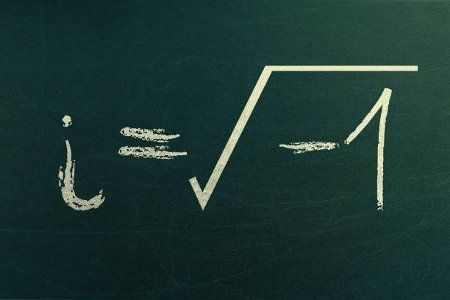
Standard numbers cannot solve every square root. This course teaches you to use complex numbers for such problems. You will learn number systems, algebra, and how to use the Argand plane. Lessons cover polar forms, De Moivre's theorem, and finding roots. You will also study sine, cosine, and log functions through many worked examples.
These methods are vital for electrical engineering, physics, and signal processing. You need these skills to calculate electricity flow and wave behaviour. Engineers use these tools to build machines and structures. Mastering this allows you to solve the difficult maths used in modern technology and research. It provides the logic needed for all advanced technical work.
You will learn to add, multiply, and divide complex numbers. You will switch between rectangular, polar, and exponential forms using Taylor series. You will gain the skill to find Nth roots of unity and solve hyperbolic equations. You will also learn to draw complex equations on a graph accurately. By the end, you will handle advanced mathematical expressions without errors.
This course is for university students in engineering or maths who must pass advanced modules. It also serves technical workers who need to refresh their skills. The step-by-step examples make the topics easy to follow for anyone starting out. This knowledge is a requirement for anyone pursuing a career in high-level science or technology.
Complex Numbers - Mathematical Methods (Undergraduate Advanced)
Standard numbers cannot solve every square root. This course teaches you to use complex numbers for such problems. You will learn number systems, algebra, and how to use the Argand plane. Lessons cover polar forms, De Moivre's theorem, and finding roots. You will also study sine, cosine, and log functions through many worked examples. These methods are vital for electrical engineering, physics, and signal processing. You need these skills to calculate electricity flow and wave behaviour. Engineers use these tools to build machines and structures. Mastering this allows you to solve the difficult maths used in modern technology and research. It provides the logic needed for all advanced technical work. You will learn to add, multiply, and divide complex numbers. You will switch between rectangular, polar, and exponential forms using Taylor series. You will gain the skill to find Nth roots of unity and solve hyperbolic equations. You will also learn to draw complex equations on a graph accurately. By the end, you will handle advanced mathematical expressions without errors. This course is for university students in engineering or maths who must pass advanced modules. It also serves technical workers who need to refresh their skills. The step-by-step examples make the topics easy to follow for anyone starting out. This knowledge is a requirement for anyone pursuing a career in high-level science or technology.

Trigonometry - Mathematics (Undergraduate Foundation)
This course provides a complete guide to trigonometry, from the principles of circular measure to functions of any angle. It covers the unit circle definitions and culminates in a full treatment of the addition and factor formulae. This is the mathematical language of cycles, waves, and angles.
A command of trigonometry is essential for any field that models periodic or geometric systems. It is used extensively in physics to analyse waves and oscillations, in engineering for structural analysis and signal processing, and in computer graphics for rotations and 3D modelling.
By the end of this course, you will be able to convert between degrees and radians, define the six trigonometric functions for any angle using the unit circle, and apply the addition and factor formulae to manipulate and simplify trigonometric expressions and solve equations.
This course is a mandatory prerequisite for any student of mathematics, physics, or engineering. It provides the necessary foundation for the study of calculus, complex numbers, and vector analysis.
Trigonometry - Mathematics (Undergraduate Foundation)
This course provides a complete guide to trigonometry, from the principles of circular measure to functions of any angle. It covers the unit circle definitions and culminates in a full treatment of the addition and factor formulae. This is the mathematical language of cycles, waves, and angles. A command of trigonometry is essential for any field that models periodic or geometric systems. It is used extensively in physics to analyse waves and oscillations, in engineering for structural analysis and signal processing, and in computer graphics for rotations and 3D modelling. By the end of this course, you will be able to convert between degrees and radians, define the six trigonometric functions for any angle using the unit circle, and apply the addition and factor formulae to manipulate and simplify trigonometric expressions and solve equations. This course is a mandatory prerequisite for any student of mathematics, physics, or engineering. It provides the necessary foundation for the study of calculus, complex numbers, and vector analysis.
Matrices, Determinants, and Systems of Linear Equations - Linear Algebra (Undergraduate Advanced)
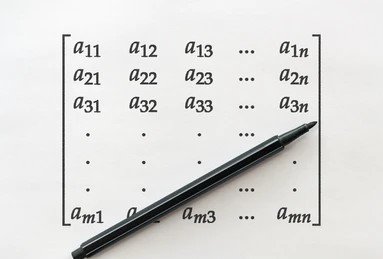
Master advanced matrix algebra and linear systems through rigorous technical training. This course covers matrix definitions; algebraic operations; transpositions; and elementary row transformations. You will investigate determinants; matrix inverses using the adjoint method; and the structural properties of similar matrices. Computational methods using MS-Excel or Google Sheets are included to handle large-scale data sets efficiently.
These mathematical structures are the engines behind modern engineering and data science. Structural engineers use matrices to calculate stress in bridges; computer scientists use them to render 3D graphics; and economists use linear systems to model market equilibrium. Mastering these tools allows you to solve multi-variable problems that are impossible to handle manually.
By the end, you will possess the skills to execute matrix additions; multiplications; and scalar operations with absolute precision. You will demonstrate competence in reducing matrices to row echelon form; calculating rank and nullity; and evaluating determinants of any order. Furthermore, you will command the ability to solve complex systems of linear equations using Cramer's rule or matrix inversion; identify special matrix types like orthogonal or symmetric; and automate these calculations using software.
This curriculum is built for undergraduate students in engineering; mathematics; and physics requiring a high-level command of linear algebra. Professionals in data science or finance will find the content vital for understanding the algorithms governing their software. Even those in general sciences will benefit from the structured logical thinking and numerical methods required to manage complex variables in any technical field.
Matrices, Determinants, and Systems of Linear Equations - Linear Algebra (Undergraduate Advanced)
Master advanced matrix algebra and linear systems through rigorous technical training. This course covers matrix definitions; algebraic operations; transpositions; and elementary row transformations. You will investigate determinants; matrix inverses using the adjoint method; and the structural properties of similar matrices. Computational methods using MS-Excel or Google Sheets are included to handle large-scale data sets efficiently. These mathematical structures are the engines behind modern engineering and data science. Structural engineers use matrices to calculate stress in bridges; computer scientists use them to render 3D graphics; and economists use linear systems to model market equilibrium. Mastering these tools allows you to solve multi-variable problems that are impossible to handle manually. By the end, you will possess the skills to execute matrix additions; multiplications; and scalar operations with absolute precision. You will demonstrate competence in reducing matrices to row echelon form; calculating rank and nullity; and evaluating determinants of any order. Furthermore, you will command the ability to solve complex systems of linear equations using Cramer's rule or matrix inversion; identify special matrix types like orthogonal or symmetric; and automate these calculations using software. This curriculum is built for undergraduate students in engineering; mathematics; and physics requiring a high-level command of linear algebra. Professionals in data science or finance will find the content vital for understanding the algorithms governing their software. Even those in general sciences will benefit from the structured logical thinking and numerical methods required to manage complex variables in any technical field.