Worked examples (1) - Theorems on Jacobians | Partial Differentiation and Its Applications - Multivariable Calculus (Undergraduate Advanced)

Partial Differentiation and Its Applications - Multivariable Calculus (Undergraduate Advanced)
This course provides a complete guide to the calculus of several variables. It builds from the foundational concepts of multivariable functions, limits, and continuity to the core techniques of differentiation, including partial derivatives, the chain rule, and implicit differentiation. The material culminates in advanced topics such as Taylor's theorem for several variables and the use of Jacobians.
Multivariable calculus is the language of modern science, engineering, and economics. Its principles are used to model complex surfaces, analyse thermodynamic systems, create 3D computer graphics, and solve critical optimisation problems in business and finance. This is the mathematical toolkit for working with systems that have multiple interacting variables.
By the end of this course, you will be able to calculate partial derivatives, apply the multivariable chain rule, and find directional derivatives using the gradient vector. You will also be able to solve both unconstrained and constrained optimisation problems by finding extreme values and using the method of Lagrange multipliers, and apply these derivatives to find tangent planes to surfaces.
This course is for students who have completed a full single-variable calculus sequence. It is the standard curriculum for a multivariable calculus (Calculus III) module and is a direct prerequisite for the study of vector calculus, differential equations, and advanced courses in physics, engineering, and economics.
Partial Differentiation and Its Applications - Multivariable Calculus (Undergraduate Advanced)
This course provides a complete guide to the calculus of several variables. It builds from the foundational concepts of multivariable functions, limits, and continuity to the core techniques of differentiation, including partial derivatives, the chain rule, and implicit differentiation. The material culminates in advanced topics such as Taylor's theorem for several variables and the use of Jacobians. Multivariable calculus is the language of modern science, engineering, and economics. Its principles are used to model complex surfaces, analyse thermodynamic systems, create 3D computer graphics, and solve critical optimisation problems in business and finance. This is the mathematical toolkit for working with systems that have multiple interacting variables. By the end of this course, you will be able to calculate partial derivatives, apply the multivariable chain rule, and find directional derivatives using the gradient vector. You will also be able to solve both unconstrained and constrained optimisation problems by finding extreme values and using the method of Lagrange multipliers, and apply these derivatives to find tangent planes to surfaces. This course is for students who have completed a full single-variable calculus sequence. It is the standard curriculum for a multivariable calculus (Calculus III) module and is a direct prerequisite for the study of vector calculus, differential equations, and advanced courses in physics, engineering, and economics.
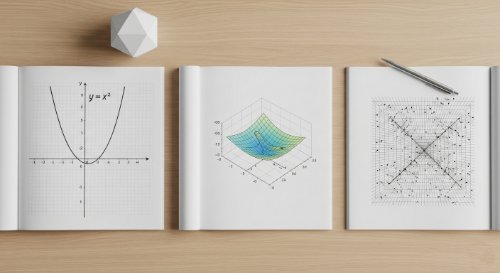
MTH 201: Mathematical Methods I
This learning track delivers the complete mathematical toolkit required for a university-level science, engineering, or computing degree. It systematically covers the entire MTH 201 curriculum, building from the foundational principles of single-variable calculus - functions, limits, continuity, and differentiability - to the advanced methods of multivariable calculus, infinite series, numerical methods, and ordinary differential equations. This is the definitive preparation for advanced quantitative study.
This programme is designed for second-year students offering MTH 201 at Obafemi Awolowo University, Ile-Ife, Nigeria. It is also helpful for any student in a STEM field - including physics, engineering, and computer science - who requires a rigorous and comprehensive command of calculus and its applications.
This track delivers a full skill set in mathematical analysis and applied problem-solving. Graduates will be able to solve a wide range of problems, from optimising multivariable functions to modelling dynamic systems with differential equations and testing the convergence of infinite series. This programme directly prepares students for success in advanced courses in vector calculus, partial differential equations, and real analysis, providing the necessary foundation for a career in engineering, data science, or theoretical physics.
MTH 201: Mathematical Methods I
This learning track delivers the complete mathematical toolkit required for a university-level science, engineering, or computing degree. It systematically covers the entire MTH 201 curriculum, building from the foundational principles of single-variable calculus - functions, limits, continuity, and differentiability - to the advanced methods of multivariable calculus, infinite series, numerical methods, and ordinary differential equations. This is the definitive preparation for advanced quantitative study. This programme is designed for second-year students offering MTH 201 at Obafemi Awolowo University, Ile-Ife, Nigeria. It is also helpful for any student in a STEM field - including physics, engineering, and computer science - who requires a rigorous and comprehensive command of calculus and its applications. This track delivers a full skill set in mathematical analysis and applied problem-solving. Graduates will be able to solve a wide range of problems, from optimising multivariable functions to modelling dynamic systems with differential equations and testing the convergence of infinite series. This programme directly prepares students for success in advanced courses in vector calculus, partial differential equations, and real analysis, providing the necessary foundation for a career in engineering, data science, or theoretical physics.
GET 209: Engineering Mathematics I
Master the mathematical language of engineering. This programme delivers the complete analytical toolkit required for a successful engineering career, covering single-variable calculus, multivariable calculus, linear algebra, and vector analysis. It provides the essential foundation for all subsequent engineering courses.
This programme is for second-year undergraduate students across all engineering disciplines. It delivers the official NUC CCMAS curriculum for Engineering Mathematics, providing the core training required for advanced modules in mechanics, thermodynamics, and circuit theory.
Model and analyse complex physical systems using calculus, linear algebra, and vector analysis. You will be equipped to solve problems in dynamics, statics, and field theory, providing the quantitative proficiency required for advanced engineering study and professional practice.
GET 209: Engineering Mathematics I
Master the mathematical language of engineering. This programme delivers the complete analytical toolkit required for a successful engineering career, covering single-variable calculus, multivariable calculus, linear algebra, and vector analysis. It provides the essential foundation for all subsequent engineering courses. This programme is for second-year undergraduate students across all engineering disciplines. It delivers the official NUC CCMAS curriculum for Engineering Mathematics, providing the core training required for advanced modules in mechanics, thermodynamics, and circuit theory. Model and analyse complex physical systems using calculus, linear algebra, and vector analysis. You will be equipped to solve problems in dynamics, statics, and field theory, providing the quantitative proficiency required for advanced engineering study and professional practice.

MTH 201: Mathematical Methods I
Advanced calculus forms the backbone of engineering, physics, and data science. This track follows the official NUC CCMAS syllabus for MTH 201 to build your mathematical foundation from scratch. You will master real-valued functions, limits, continuity, and differentiability before moving to partial differentiation and multiple integration. The content moves from single-variable theory to multivariable applications used in real-world modelling. Each module uses strict definitions and repeated worked examples to ensure you can solve problems under exam pressure. This is not just theory; it is the practical toolkit required for technical degrees and professional analysis.
This programme targets undergraduates in engineering, physical sciences, and mathematics. It suits learners who need to pass MTH 201 with high marks or build a strong base for advanced studies. Secondary school leavers with strong algebra skills can use this track to prepare for university-level rigour. Professionals returning to technical fields will refresh their analytical abilities quickly. If you plan to work in structural design, circuit analysis, fluid dynamics, or economic modelling, this track provides the essential mathematical language you must command.
You will analyse domain, range, and behaviour of complex functions without hesitation. You will evaluate limits and prove continuity using formal logical bounds. You will apply differentiation rules, Rolle's theorem, and Taylor series to approximate and optimise systems. You will compute partial derivatives and solve constrained optimisation problems using Lagrange multipliers. You will perform multiple integration over lines, surfaces, and volumes. These skills prepare you for vector calculus, differential equations, and core engineering courses. You will gain the confidence to handle advanced technical coursework and professional modelling tasks with precision.
MTH 201: Mathematical Methods I
Advanced calculus forms the backbone of engineering, physics, and data science. This track follows the official NUC CCMAS syllabus for MTH 201 to build your mathematical foundation from scratch. You will master real-valued functions, limits, continuity, and differentiability before moving to partial differentiation and multiple integration. The content moves from single-variable theory to multivariable applications used in real-world modelling. Each module uses strict definitions and repeated worked examples to ensure you can solve problems under exam pressure. This is not just theory; it is the practical toolkit required for technical degrees and professional analysis. This programme targets undergraduates in engineering, physical sciences, and mathematics. It suits learners who need to pass MTH 201 with high marks or build a strong base for advanced studies. Secondary school leavers with strong algebra skills can use this track to prepare for university-level rigour. Professionals returning to technical fields will refresh their analytical abilities quickly. If you plan to work in structural design, circuit analysis, fluid dynamics, or economic modelling, this track provides the essential mathematical language you must command. You will analyse domain, range, and behaviour of complex functions without hesitation. You will evaluate limits and prove continuity using formal logical bounds. You will apply differentiation rules, Rolle's theorem, and Taylor series to approximate and optimise systems. You will compute partial derivatives and solve constrained optimisation problems using Lagrange multipliers. You will perform multiple integration over lines, surfaces, and volumes. These skills prepare you for vector calculus, differential equations, and core engineering courses. You will gain the confidence to handle advanced technical coursework and professional modelling tasks with precision.