Welcome - Introduction | Force and Motion: Newton's Laws - Physics (Undergraduate Foundation)
Force and Motion: Newton's Laws - Physics (Undergraduate Foundation)
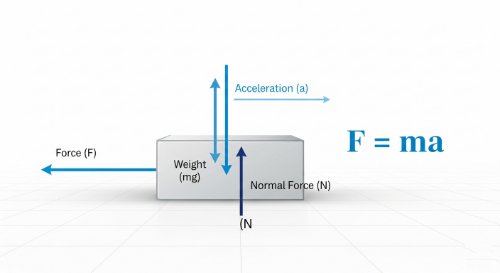
Dynamics explains why objects move, and Newton's laws provide the exact mathematical rules for this movement. This course transitions from basic motion to the rigorous use of force vectors, inertia, and action-reaction pairs. You will learn to handle gravity, tension, and springs while solving resistive problems involving static, kinetic, and fluid friction. We build from first principles to complex systems used in modern machinery.
Every machine and structure operates under these principles. Understanding these forces is required to predict when a system will fail, how to build safe cars, and how to design efficient engines. These analytical tools allow you to solve real problems in construction, manufacturing, and transport. This knowledge is the foundation for anyone building or maintaining physical systems.
After this course, you will construct precise free-body diagrams to isolate objects from their surroundings. You will acquire the technical skill to calculate acceleration in systems with multiple forces, find centripetal force for circular motion, and use equilibrium laws to find unknown force values. You will master the mathematics of friction on ramps, calculate terminal velocity in fluids, and solve for tension in connected pulley systems.
This course is for first-year university engineering and physics students. It also helps technicians who need a refresher and secondary school leavers who want to prepare for undergraduate work. Anyone interested in how things work will find these structured methods useful for clear thinking and scientific problem-solving.
Force and Motion: Newton's Laws - Physics (Undergraduate Foundation)
Dynamics explains why objects move, and Newton's laws provide the exact mathematical rules for this movement. This course transitions from basic motion to the rigorous use of force vectors, inertia, and action-reaction pairs. You will learn to handle gravity, tension, and springs while solving resistive problems involving static, kinetic, and fluid friction. We build from first principles to complex systems used in modern machinery. Every machine and structure operates under these principles. Understanding these forces is required to predict when a system will fail, how to build safe cars, and how to design efficient engines. These analytical tools allow you to solve real problems in construction, manufacturing, and transport. This knowledge is the foundation for anyone building or maintaining physical systems. After this course, you will construct precise free-body diagrams to isolate objects from their surroundings. You will acquire the technical skill to calculate acceleration in systems with multiple forces, find centripetal force for circular motion, and use equilibrium laws to find unknown force values. You will master the mathematics of friction on ramps, calculate terminal velocity in fluids, and solve for tension in connected pulley systems. This course is for first-year university engineering and physics students. It also helps technicians who need a refresher and secondary school leavers who want to prepare for undergraduate work. Anyone interested in how things work will find these structured methods useful for clear thinking and scientific problem-solving.
PHY 101: General Physics I - Mechanics
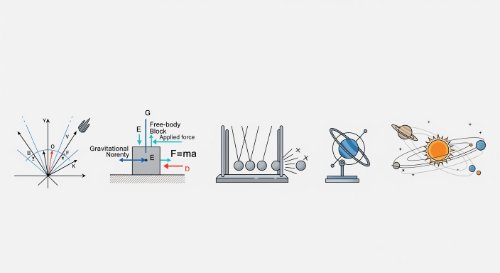
This learning track provides a complete and rigorous treatment of introductory classical mechanics as specified by the NUC Core Curriculum. It is structured to build a comprehensive analytical framework, starting with the mathematical description of motion (kinematics) and progressing through its causes (Newtonian dynamics), the powerful conservation laws, the dynamics of rotating systems, and finally, the principles of universal gravitation. Mastery of this material is the non-negotiable foundation for all subsequent study in physics and engineering.
The principles of classical mechanics are the operational language for analysing the physical world. This track provides the essential toolset for solving problems in every field of engineering, from aerospace to civil, and for understanding phenomena from the trajectory of a projectile to the orbits of planets. By the end of this track, you will be able to analyse motion using vectors and calculus, apply Newton's laws to solve any standard dynamics problem, use conservation laws to analyse complex systems and collisions, analyse rotational motion, and solve problems in celestial mechanics.
This learning track is a mandatory prerequisite for all first-year university students of physics, engineering, and related physical sciences. It provides the foundational knowledge required for all subsequent courses in mechanics, electromagnetism, thermodynamics, and modern physics.
PHY 101: General Physics I - Mechanics
This learning track provides a complete and rigorous treatment of introductory classical mechanics as specified by the NUC Core Curriculum. It is structured to build a comprehensive analytical framework, starting with the mathematical description of motion (kinematics) and progressing through its causes (Newtonian dynamics), the powerful conservation laws, the dynamics of rotating systems, and finally, the principles of universal gravitation. Mastery of this material is the non-negotiable foundation for all subsequent study in physics and engineering. The principles of classical mechanics are the operational language for analysing the physical world. This track provides the essential toolset for solving problems in every field of engineering, from aerospace to civil, and for understanding phenomena from the trajectory of a projectile to the orbits of planets. By the end of this track, you will be able to analyse motion using vectors and calculus, apply Newton's laws to solve any standard dynamics problem, use conservation laws to analyse complex systems and collisions, analyse rotational motion, and solve problems in celestial mechanics. This learning track is a mandatory prerequisite for all first-year university students of physics, engineering, and related physical sciences. It provides the foundational knowledge required for all subsequent courses in mechanics, electromagnetism, thermodynamics, and modern physics.