Laws of algebra - Introduction | Operations with Real Numbers - Mathematics (Undergraduate Foundation)
Operations with Real Numbers - Mathematics (Undergraduate Foundation)
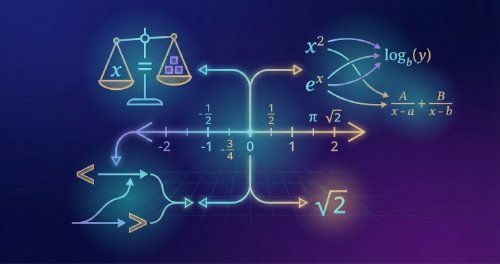
Mathematics requires absolute precision. This course provides a rigorous grounding in real number operations, from integers and rational numbers to complex systems and algebraic laws. You will learn to handle polynomials, solve equations ranging from linear to biquadratic, and navigate simultaneous systems. The syllabus covers inequalities, sign tables, partial fractions, indices, logarithms, and the systematic simplification of surds.
These tools are essential for success in engineering, accounting, and the sciences. Clear mathematical thinking allows you to model financial risks, calculate structural loads, and write efficient computer code. Proficiency in these operations ensures accuracy in any career that relies on quantitative data and logical deduction.
You will gain the ability to classify number systems, apply algebraic theorems, and solve complex equations in one or more unknowns. You will acquire the skills to manipulate inequalities, resolve algebraic fractions, and simplify expressions using the laws of indices and logarithms. The course provides the technical competence required to handle surds and find roots of compound expressions effectively.
This training is built for undergraduate foundation students and secondary school leavers entering university. It provides a necessary bridge for anyone needing to strengthen their mathematical base before advanced study. Even those in non-technical roles will find value in the disciplined analytical approach required to master these foundational concepts.
Operations with Real Numbers - Mathematics (Undergraduate Foundation)
Mathematics requires absolute precision. This course provides a rigorous grounding in real number operations, from integers and rational numbers to complex systems and algebraic laws. You will learn to handle polynomials, solve equations ranging from linear to biquadratic, and navigate simultaneous systems. The syllabus covers inequalities, sign tables, partial fractions, indices, logarithms, and the systematic simplification of surds. These tools are essential for success in engineering, accounting, and the sciences. Clear mathematical thinking allows you to model financial risks, calculate structural loads, and write efficient computer code. Proficiency in these operations ensures accuracy in any career that relies on quantitative data and logical deduction. You will gain the ability to classify number systems, apply algebraic theorems, and solve complex equations in one or more unknowns. You will acquire the skills to manipulate inequalities, resolve algebraic fractions, and simplify expressions using the laws of indices and logarithms. The course provides the technical competence required to handle surds and find roots of compound expressions effectively. This training is built for undergraduate foundation students and secondary school leavers entering university. It provides a necessary bridge for anyone needing to strengthen their mathematical base before advanced study. Even those in non-technical roles will find value in the disciplined analytical approach required to master these foundational concepts.
MTH 101: Elementary Mathematics I - Algebra and Trigonometry
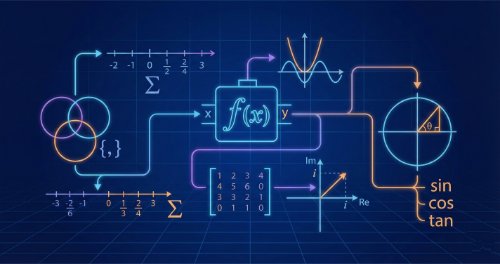
Master the foundational mathematical structures essential for success in quantitative undergraduate degrees and professional technical roles. This comprehensive learning track delivers a rigorous treatment of algebra and trigonometry, moving rapidly from fundamental set theory and real number operations to advanced topics including matrix algebra, complex numbers, and analytical trigonometry. You will establish the critical problem-solving framework required for advanced study in calculus, engineering mechanics, and data science.
This programme is primarily designed for first-year university students in STEM disciplines requiring strong analytical bases, particularly engineering, physics, computer science, and economics. It also serves as an intensive, high-level refresher for professionals returning to academia or shifting into data-driven roles demanding precise numerical literacy and logical structuring. Prior competence in standard secondary school mathematics is assumed; focus is placed strictly on mastery and application of core definitions.
Upon completion, you will possess the skills to construct rigorous logical arguments using set theory and mathematical induction, model complex relationships with functions and matrices, and analyze periodic systems using advanced trigonometry. You will demonstrate competence in solving diverse equation types, from quadratics to linear systems, and manipulating complex numbers in engineering applications. This track prepares you directly for the mathematical demands of second-year university studies and technical professional certification exams.
MTH 101: Elementary Mathematics I - Algebra and Trigonometry
Master the foundational mathematical structures essential for success in quantitative undergraduate degrees and professional technical roles. This comprehensive learning track delivers a rigorous treatment of algebra and trigonometry, moving rapidly from fundamental set theory and real number operations to advanced topics including matrix algebra, complex numbers, and analytical trigonometry. You will establish the critical problem-solving framework required for advanced study in calculus, engineering mechanics, and data science. This programme is primarily designed for first-year university students in STEM disciplines requiring strong analytical bases, particularly engineering, physics, computer science, and economics. It also serves as an intensive, high-level refresher for professionals returning to academia or shifting into data-driven roles demanding precise numerical literacy and logical structuring. Prior competence in standard secondary school mathematics is assumed; focus is placed strictly on mastery and application of core definitions. Upon completion, you will possess the skills to construct rigorous logical arguments using set theory and mathematical induction, model complex relationships with functions and matrices, and analyze periodic systems using advanced trigonometry. You will demonstrate competence in solving diverse equation types, from quadratics to linear systems, and manipulating complex numbers in engineering applications. This track prepares you directly for the mathematical demands of second-year university studies and technical professional certification exams.

AMS 102: Basic Mathematics
Management and administration require precise numerical logic for decision-making. This track follows the official NUC CCMAS syllabus for AMS 102, covering real numbers, set theory, and complex systems. You will master algebraic operations, permutations, and combinations alongside the foundations of trigonometry and calculus. It provides the mathematical tools to model financial trends, handle business data, and solve optimisation problems in corporate settings.
This programme is built for first-year university students in Accounting, Business Administration, Banking, Finance, and Public Administration. It also serves secondary school leavers preparing for management degrees and professionals needing a refresher on business mathematics. It is suitable for anyone moving into roles that demand accurate quantitative analysis and logical deduction.
You will gain the ability to simplify complex business formulas, calculate probabilities for risk assessment, and find the exact points where profits are highest. You will be able to handle sequences for interest calculations and use differentiation to manage production costs. Completing this track ensures success in university examinations and builds the analytical strength required for careers in financial analysis, auditing, and strategic management.
AMS 102: Basic Mathematics
Management and administration require precise numerical logic for decision-making. This track follows the official NUC CCMAS syllabus for AMS 102, covering real numbers, set theory, and complex systems. You will master algebraic operations, permutations, and combinations alongside the foundations of trigonometry and calculus. It provides the mathematical tools to model financial trends, handle business data, and solve optimisation problems in corporate settings. This programme is built for first-year university students in Accounting, Business Administration, Banking, Finance, and Public Administration. It also serves secondary school leavers preparing for management degrees and professionals needing a refresher on business mathematics. It is suitable for anyone moving into roles that demand accurate quantitative analysis and logical deduction. You will gain the ability to simplify complex business formulas, calculate probabilities for risk assessment, and find the exact points where profits are highest. You will be able to handle sequences for interest calculations and use differentiation to manage production costs. Completing this track ensures success in university examinations and builds the analytical strength required for careers in financial analysis, auditing, and strategic management.

DSS 103: Mathematics for Social Scientists I - Algebra and Trigonometry
Build the mathematical foundation required to excel in social science degrees and data-driven careers. This track follows the official NUC syllabus for DSS 103 to teach sets, number operations, counting methods, logical proofs, binomial expansions, complex numbers, and trigonometry. Each topic connects directly to the quantitative skills you need for statistics, research methods, and economic analysis.
This programme is for first-year university students studying economics, sociology, political science, psychology, geography, or other social science disciplines. It is also for secondary school leavers preparing for university entry and professionals who must strengthen their maths for postgraduate study or analytical roles in government, NGOs, or private sector research.
After completing this track, you will solve equations, handle algebraic proofs, manipulate trigonometric formulas, and apply counting principles to real-world data problems. These skills prepare you for advanced coursework in econometrics, statistical analysis, social research, and policy evaluation. You will have the confidence to tackle quantitative modules and compete for roles in banking, public service, consulting, and development work.
DSS 103: Mathematics for Social Scientists I - Algebra and Trigonometry
Build the mathematical foundation required to excel in social science degrees and data-driven careers. This track follows the official NUC syllabus for DSS 103 to teach sets, number operations, counting methods, logical proofs, binomial expansions, complex numbers, and trigonometry. Each topic connects directly to the quantitative skills you need for statistics, research methods, and economic analysis. This programme is for first-year university students studying economics, sociology, political science, psychology, geography, or other social science disciplines. It is also for secondary school leavers preparing for university entry and professionals who must strengthen their maths for postgraduate study or analytical roles in government, NGOs, or private sector research. After completing this track, you will solve equations, handle algebraic proofs, manipulate trigonometric formulas, and apply counting principles to real-world data problems. These skills prepare you for advanced coursework in econometrics, statistical analysis, social research, and policy evaluation. You will have the confidence to tackle quantitative modules and compete for roles in banking, public service, consulting, and development work.