MTH 205: Linear Algebra II
42 hrs
$ 20.99
Learning Track Courses
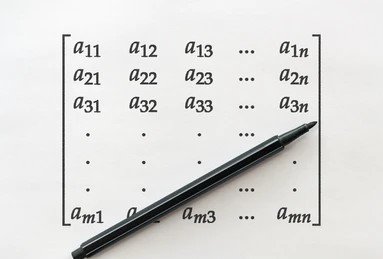
Matrices, Determinants, and Systems of Linear Equations - Linear Algebra (Undergraduate Advanced)
Master advanced matrix algebra and linear systems through rigorous technical training. This course covers matrix definitions; algebraic operations; transpositions; and elementary row transformations. You will investigate determinants; matrix inverses using the adjoint method; and the structural properties of similar matrices. Computational methods using MS-Excel or Google Sheets are included to handle large-scale data sets efficiently.
These mathematical structures are the engines behind modern engineering and data science. Structural engineers use matrices to calculate stress in bridges; computer scientists use them to render 3D graphics; and economists use linear systems to model market equilibrium. Mastering these tools allows you to solve multi-variable problems that are impossible to handle manually.
By the end, you will possess the skills to execute matrix additions; multiplications; and scalar operations with absolute precision. You will demonstrate competence in reducing matrices to row echelon form; calculating rank and nullity; and evaluating determinants of any order. Furthermore, you will command the ability to solve complex systems of linear equations using Cramer's rule or matrix inversion; identify special matrix types like orthogonal or symmetric; and automate these calculations using software.
This curriculum is built for undergraduate students in engineering; mathematics; and physics requiring a high-level command of linear algebra. Professionals in data science or finance will find the content vital for understanding the algorithms governing their software. Even those in general sciences will benefit from the structured logical thinking and numerical methods required to manage complex variables in any technical field.
Matrices, Determinants, and Systems of Linear Equations - Linear Algebra (Undergraduate Advanced)
Master advanced matrix algebra and linear systems through rigorous technical training. This course covers matrix definitions; algebraic operations; transpositions; and elementary row transformations. You will investigate determinants; matrix inverses using the adjoint method; and the structural properties of similar matrices. Computational methods using MS-Excel or Google Sheets are included to handle large-scale data sets efficiently. These mathematical structures are the engines behind modern engineering and data science. Structural engineers use matrices to calculate stress in bridges; computer scientists use them to render 3D graphics; and economists use linear systems to model market equilibrium. Mastering these tools allows you to solve multi-variable problems that are impossible to handle manually. By the end, you will possess the skills to execute matrix additions; multiplications; and scalar operations with absolute precision. You will demonstrate competence in reducing matrices to row echelon form; calculating rank and nullity; and evaluating determinants of any order. Furthermore, you will command the ability to solve complex systems of linear equations using Cramer's rule or matrix inversion; identify special matrix types like orthogonal or symmetric; and automate these calculations using software. This curriculum is built for undergraduate students in engineering; mathematics; and physics requiring a high-level command of linear algebra. Professionals in data science or finance will find the content vital for understanding the algorithms governing their software. Even those in general sciences will benefit from the structured logical thinking and numerical methods required to manage complex variables in any technical field.
Eigenvalues, Eigenvectors and Diagonalization of Matrices - Linear Algebra (Undergraduate Advanced)
This course provides a clear and structured exploration of eigenvalues, eigenvectors, and diagonalization, focusing on both theory and real-world applications.
You???ll learn how to compute eigenvalues and eigenvectors, understand their geometric significance, and apply diagonalization to simplify complex matrix operations.
Topics include linear transformations, dynamical systems, and applications in physics, engineering, and machine learning.
The course is designed for students, engineers, and data scientists seeking a strong foundation in matrix methods. By the end, you'll confidently apply these concepts in problem-solving and computational modeling.
Eigenvalues, Eigenvectors and Diagonalization of Matrices - Linear Algebra (Undergraduate Advanced)
This course provides a clear and structured exploration of eigenvalues, eigenvectors, and diagonalization, focusing on both theory and real-world applications. You???ll learn how to compute eigenvalues and eigenvectors, understand their geometric significance, and apply diagonalization to simplify complex matrix operations. Topics include linear transformations, dynamical systems, and applications in physics, engineering, and machine learning. The course is designed for students, engineers, and data scientists seeking a strong foundation in matrix methods. By the end, you'll confidently apply these concepts in problem-solving and computational modeling.